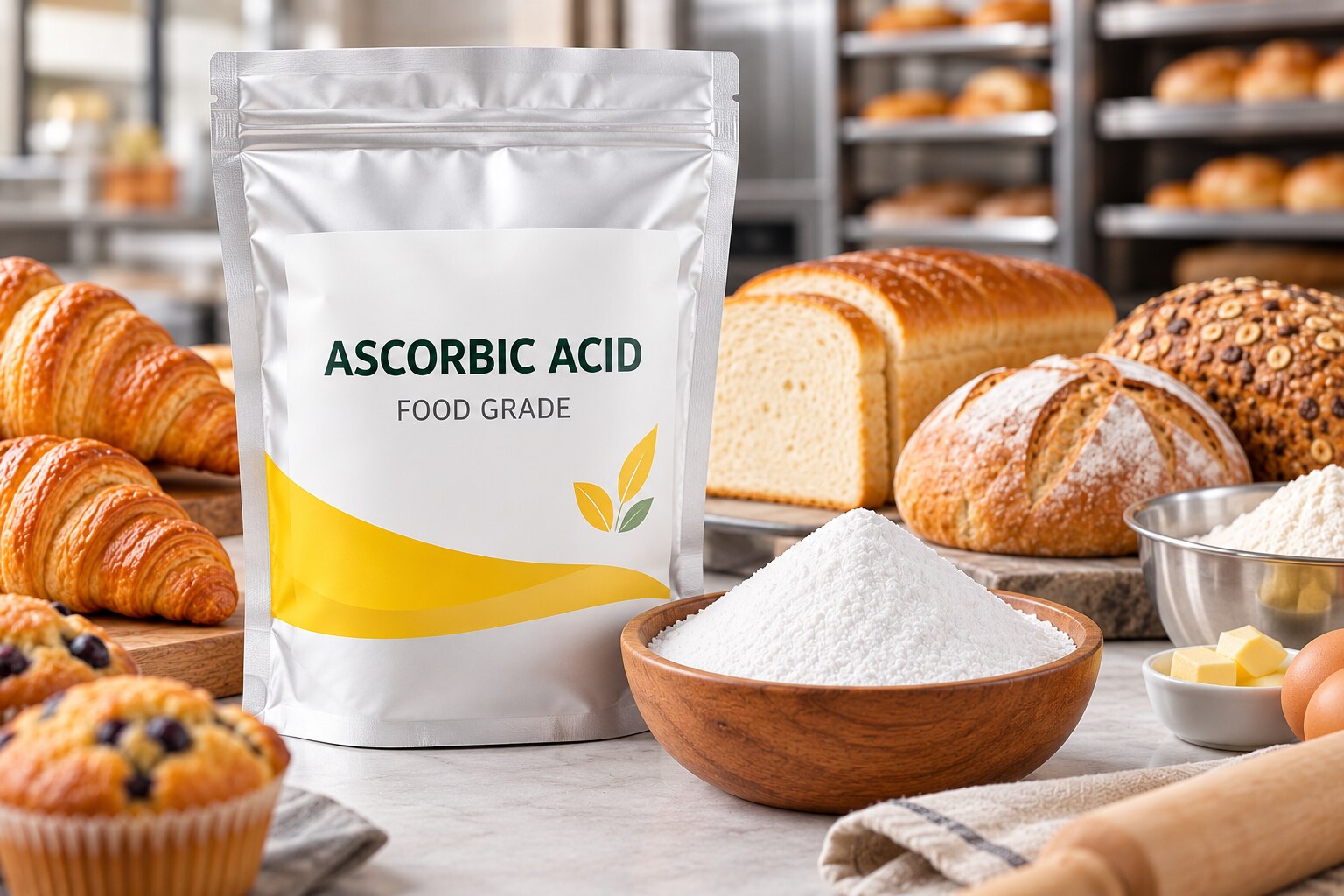
Choosing a vitamin C ingredient for bakery depends on whether you need dough oxidation, fat-phase antioxidant protection, acidity control, or finished-product fortification. By comparing chemical form, process behaviour, assay, stability, and Indian labelling requirements, you can select an ingredient that performs reliably in bread, biscuits, cakes, premixes, fillings, and confectionery.
Key takeaways
- Choose L-ascorbic acid when dough strength, gas retention, and machinability matter.
- Compare each vitamin C form by pH, taste, texture, solubility, and product fit.
- Run controlled dough trials before changing form or dose in production.
- Request INS 300 identity, assay, batch documents, and food-grade compliance records.
Why L-ascorbic acid strengthens wheat dough
L-ascorbic acid, identified as INS 300 or E300, is the conventional vitamin C ingredient for bakery dough conditioning because it strengthens the dough system during processing. Mixing and fermentation oxidise ascorbic acid to dehydroascorbic acid, producing a redox effect that supports gluten development, gas retention, dough tolerance, loaf volume, crumb structure, and machinability.
The function is processing performance, not automatically a nutrition benefit. Bread containing L-ascorbic acid as a dough improver does not deliver a declared vitamin C amount unless retention after baking, cooling, and storage has been established.
- Add it through a validated flour premix or accurately metered dough-improver system.
- Disperse it uniformly before hydration; localised high concentrations can produce uneven dough strength.
- Compare pilot batches by dough development time, mixing tolerance, fermentation stability, loaf volume, crumb cell structure, and handling.
- Set the inclusion level against flour strength, mixing energy, fermentation time, dough hydration, and product format.
A larger dose is not automatically better. Excessive or poorly dispersed ascorbic acid can make dough behaviour inconsistent, causing variable extensibility, tearing, moulding, or gas retention even when the supplier’s assay is correct.
This is why ascoric acid vs other vitamin c forms bakery in delhi should be judged by equivalent activity and process results, not ingredient identity or purchase weight alone.
How vitamin C forms change pH, taste, texture, and product fit
Compare forms at equal ascorbic-acid activity, not equal kilograms. That is the central issue in an ascorbic acid vs other vitamin C forms bakery in Delhi assessment: a buffered salt can weigh more yet deliver the same vitamin C activity, while changing dough pH, mineral balance, taste, and ingredient interactions.
| Option | pH and taste | Texture, colour, and product fit |
|---|---|---|
| L-ascorbic acid | Lowers pH and can add sourness | Conventional dough conditioner; supports crumb and gas retention |
| Sodium ascorate (INS 301) | Less acidic; adds sodium | Useful when acidity is unwelcome, but check sodium declarations and dough response |
| Calcium ascorbate (INS 302) | Less acidic; adds calcium and possible mineral notes | Consider when calcium fits the formula; verify crumb and finished-product pH |
| Other mineral ascorbates | Buffered; mineral taste depends on the carrier | Compare mineral contribution, label impact, and mixing performance |
| Ascorbyl palmitate (INS 304(i)) | Fat-soluble, with little aqueous dough effect | Better for fat-containing fillings, coatings, and vitamin C for confectionery formulations than wheat dough |
| Coated or encapsulated vitamin C | Release controls acidity and sourness | Evaluate dispersion, heat exposure, and storage stability |
| Acerola or citrus sources | Acidity, colour, flavour, and activity vary | Check lot consistency, flavour, and nutritional declaration before use |
Citric acid only adjusts acidity and pH; it does not create the same dough-oxidation function as L-ascorbic acid, so it is not a direct bread-improver substitute. In sweet goods, its acid-base reaction can alter leavening, colour, or gel behaviour. A nutrition declaration also requires retention testing after baking and storage, not merely the amount added.
How to test and dose each form in a bakery process
Run a control batch and one pilot at a time, matching flour, hydration, mixing energy, fermentation, and bake profile. Dose L-ascorbic acid through a validated flour premix, accurately metered dough improver, or fully dissolved process water; never tip powder onto wet dough, where local high concentration causes uneven development.
Compare at equivalent ascorbic-acid activity, not equal weight.
- Record dough development time, mixing tolerance, extensibility, fermentation stability, machinability, loaf volume, crumb-cell structure, finished-product pH, and taste.
- Repeat with strong and weak flour, straight dough and preferment, short and long fermentation, and hand versus high-shear mixing. For buns, biscuits, cakes, or premixes, test the actual formula rather than transferring bread results.
- Increase dispersion control before increasing dose. A weak flour may need a different conditioning target; excessive treatment can produce tight dough, poor extensibility, or irregular cells.
| Form | Best pilot use | Reject or investigate when |
|---|---|---|
| L-ascorbic acid | Aqueous wheat dough conditioning; standard vitamin C ingredient for bakery | Acidity or hot spots damage flavour or handling |
| Sodium/calcium ascorate | Acid-sensitive doughs needing sodium or calcium | Mineral balance, cost, or pH worsens |
| Coated or natural acerola/citrus | Nutrition-led products after retention testing | Activity falls during heat or storage |
| Ascorbyl palmitate | Fat phase, fillings, coatings, and vitamin c for confectionery formulations | Used to replace gluten oxidation in bread |
For fillings, fondants, gummies, compound coatings, and aerated confectionery, test solubility, water activity, fat phase, heat exposure, and acid-base balance separately. Reject a form when prolonged storage or unstable activity fails the actual matrix.
What to request from an ascorbic acid supplier in Delhi
Request a recent, lot-specific certificate of analysis from any ascorbic acid food ingredient supplier, not a generic specification sheet. It should show assay, identity, moisture or loss on drying, heavy metals, applicable microbiological limits, particle characteristics, packaging details, lot number, traceability, manufacture date, and expiry or retest date.
Ask the supplier to document these practical controls:
- Solubility, particle-size distribution, batch-to-batch consistency, allergen status, recommended storage temperature and humidity, and retest policy.
- Sealed packaging that protects against heat, moisture, light, and oxygen; inspect every delivery for punctures, swelling, broken seals, or caking.
- Import-lot records linking the Indian shipment to the manufacturer, continuity-of-supply plans, and support for controlled application trials.
Compare suppliers on the evidence you receive, not on “food grade” wording alone.
| Evidence | Why it matters | What to verify |
|---|---|---|
| Lot-specific COA | Confirms the delivered material | Assay, identity, moisture, heavy metals, microbiology, lot and shelf life |
| Application data | Connects quality to bakery performance | Solubility, particle size, dispersion, equivalent activity versus sodium or calcium ascorbate |
| Supply controls | Protects consistency | Import traceability, storage logs, packaging integrity, retest process and stock continuity |
Pharmaceutical-grade paperwork proves neither suitability for a food process nor compliance with an Indian ingredient or finished-food label. A bakery also needs evidence that low-dose powder will disperse uniformly and remain suitable after storage.
YNP Ingredients Pvt Ltd is one Delhi-based sourcing option to assess against these documents, storage controls, continuity commitments, and trial support—not a substitute for comparing the material objectively.
Related product
 | Vitamins (Vitamin C) is a water-soluble vitamin widely used in nutraceutical and food ingredients formulations for its antioxidant properties, immune support,... View product → |
When processing aid use becomes a vitamin C nutrition claim
A dose added to dough is not the amount you can declare in the loaf. Heat during baking, oxygen exposure during cooling, and storage time reduce vitamin C, so a dough improver or processing aid serves a technological function unless retained vitamin C has been demonstrated.
A fortification or nutrition claim requires a retention calculation, testing after the actual bake profile and shelf life, and review of the proposed wording against current Food Safety and Standards Authority of India (FSSAI) provisions. Conditioning performance supports processing; measured nutrient content supports declaration.
Before approving an ascorbic acid food ingredient supplier, verify:
- The additive identity against current FSSAI food-additives provisions.
- The permitted food category and maximum use level, where applicable.
- The importer’s or distributor’s applicable FSSAI food-business licence.
- The proposed label declaration against the retained amount, not the initial dough dose.
For an ascorbic acid vs other vitamin C forms for bakery in Delhi decision, use this rule:
| Form | Choose it for | Gate before use |
|---|---|---|
| L-ascorbic acid | Validated dough conditioning | Confirm dispersion and dough-performance results |
| Sodium or calcium ascorbate | Lower acidity or a sodium/mineral requirement | Check pH, taste, and mineral declarations |
| Fat-soluble derivatives | Suitable fillings, coatings, or lipid systems | Test stability in the actual fat phase |
| Protected or natural sources | Nutritional delivery where stability is difficult | Complete matrix-specific stability and label testing |
Frequently asked questions
Why does L-ascorbic acid strengthen wheat dough?
Mixing and fermentation oxidise L-ascorbic acid to dehydroascorbic acid, supporting gluten development, gas retention, dough tolerance, loaf volume, crumb structure, and machinability.
How do vitamin C forms affect bakery products?
Different forms can change pH, taste, texture, solubility, and process performance, so compare them against the specific bakery product and production method.
How should you test and dose vitamin C forms in a bakery process?
Run controlled trials that keep flour, water, mixing, fermentation, and baking conditions consistent, then compare dough handling, volume, crumb, taste, and process tolerance.
What should you request from an ascorbic acid supplier in Delhi?
Request the ingredient identity, INS 300 or E300 designation where applicable, assay, batch number, certificate of analysis, specification sheet, food-grade documentation, and storage details.
When does processing-aid use become a vitamin C nutrition claim?
The distinction depends on how the ingredient is used and what appears on the finished product label. Review the formulation, residual amount, and proposed claim before making a nutrition statement.
Keywords